
Top Stories
Coastal Erosion Risks Surge on Hibiscus Coast Following Heavy Rain

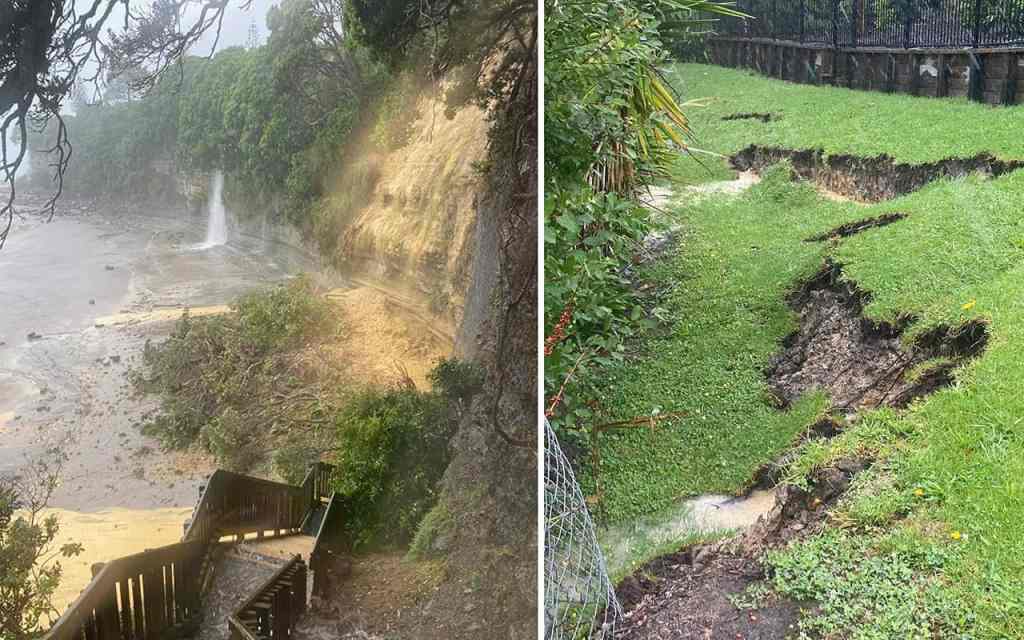
Heavy rains and strong winds earlier this year triggered a series of coastal slips on the Hibiscus Coast, leading to the closure of several public access points, including the Pacific Parade stairs in Army Bay and parts of the Arkles Bay coastal walkway. Additionally, fencing controls were implemented at the Red Beach headland near Chelverton Terrace. In response to these incidents, the Auckland Council has undertaken geotechnical reviews of the affected locations, maintaining closures while stability assessments continue.
To better understand the reasons behind the frequent slips along the peninsula’s coastline, Hibiscus Matters spoke with Professor Mark Dickson, a coastal geomorphologist at the University of Auckland. He explained that the coastal erosion affecting the cliffs involves a combination of natural processes. “There is an interaction between marine processes, like wave action and intertidal weathering, and the inherent geotechnical weaknesses of the soft rocks in the area,” he stated.
The local geology consists of alternating layers of sandstone and siltstone, which are particularly vulnerable to erosion. The persistent action of waves and weathering gradually erodes the base of the cliffs, maintaining a steep face that is prone to landslides. Prolonged periods of rainfall can exacerbate these conditions by increasing pressure on the rock layers, ultimately leading to various types of landsliding failures.
Professor Dickson noted that specific geological characteristics, such as the dip of bedding planes and existing defects within the rock mass, can influence the nature of these failures. He emphasized the challenges of preventing landslides, stating, “Coastal cliff erosion is a global problem,” and highlighted that while engineered seawalls have been used to protect cliff bases, they can sometimes lead to unforeseen adverse effects. One such issue is the phenomenon of “end effects,” where erosion is concentrated in areas adjacent to the protected zone.
Cliff erosion can also play a role in sediment replenishment for nearby beaches, meaning that interventions to stop erosion in one location may unintentionally increase it in another. Professor Dickson suggested that establishing cliff-top buffer zones could be beneficial by limiting the encroachment of development toward the cliff edges.
As erosion and landslides are natural phenomena, the risks they pose are being increasingly recognized as residential areas, walkways, and public infrastructure encroach upon unstable coastal margins. Notably, slips can occur even after heavy rain has ceased, as residual water continues to infiltrate the cliffs, weakening the already fragile layers. This was tragically illustrated by a recent landslide in Mt Maunganui that resulted in fatalities.
In light of these hazards, the Auckland Council is adopting a more robust, risk-based approach to managing coastal hazards. The Unitary Plan’s coastal hazards framework is undergoing revisions through Proposed Plan Change 120. This initiative introduces stricter regulations for development in high-risk areas and is currently in effect while public submissions and hearings are ongoing.
To enhance public awareness, the Council has made information about coastal hazards and landslide risks more accessible online and in property information reports. For residents and potential buyers on the Hibiscus Coast, consulting hazard maps prior to making design or purchasing decisions is becoming increasingly critical. As the landscape shifts due to natural processes, understanding these risks will be essential for ensuring safety and sustainability in the region.












New $25 Million Funding Boosts Hospital Capacity Ahead of Winter

Discover Sleep Space’s Affordable Bach Bed Packages Today

Jury Dismissed in Sexual Assault Trial Over Misguided Questions

Wellington’s New Gallery Unveils Community-Driven Art Exhibition

All Whites Face Challenges as Injuries Strike Before World Cup

Heroic Bystander Rescues Swimmers from Dangerous Surf in Napier

Nina Oyama Returns to Crime Comedy in Deadloch Season 2

China Southern Airlines Offers Reliable Journey from Auckland to Vietnam

Nina Oyama Returns to Deadloch for Anticipated Season 2

Community Mourns Teens Lost in Mount Maunganui Landslide

Tributes Pour In for Lachlan Rofe, Reality Star, Dead at 47

Private Funeral Held for Dean Field and His Three Children

Funeral Planned for Field Siblings After Tragic House Fire

Netball New Zealand Stands Down Dame Noeline Taurua for Series

Al Waha Motors Opens Flagship Jetour Showroom in Al Khor

Julian Dennison Ties the Knot with Christian Baledrokadroka in New Zealand

Auckland’s Average Rent Surpasses $700 for Three-Bedroom Homes

New Research Reveals Simple Path to Enhanced Happiness
-
 Top Stories7 months ago
Community Mourns Teens Lost in Mount Maunganui Landslide
-
 Entertainment11 months ago
Tributes Pour In for Lachlan Rofe, Reality Star, Dead at 47
-
 World9 months ago
Private Funeral Held for Dean Field and His Three Children
-
 Top Stories9 months ago
Funeral Planned for Field Siblings After Tragic House Fire
-
 Sports11 months ago
Netball New Zealand Stands Down Dame Noeline Taurua for Series
-
 Health6 months ago
Al Waha Motors Opens Flagship Jetour Showroom in Al Khor
-
 Entertainment7 months ago
Julian Dennison Ties the Knot with Christian Baledrokadroka in New Zealand
-
 Business7 months ago
Auckland’s Average Rent Surpasses $700 for Three-Bedroom Homes
-
 Science10 months ago
New Research Reveals Simple Path to Enhanced Happiness
-

 Entertainment10 months ago
New ‘Maverick’ Chaser Joins Beat the Chasers Season Finale
-

 Lifestyle10 months ago
Maia Wilson Faces Backlash Following Taurua’s Suspension
-

 Sports10 months ago
All Blacks Star Damian McKenzie and Partner Announce Baby News