
Health
South Korea’s Death Industry Expands Amid Aging Population

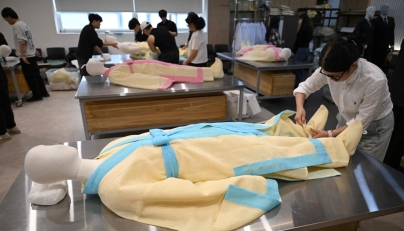
In South Korea, a significant shift in demographics is reshaping the funeral industry. With one of the world’s lowest birth rates and nearly half of the population aged 50 or older, the demand for funeral services is on the rise. The Busan Institute of Science and Technology is training future funeral directors, equipping them with the skills needed in a society that increasingly faces the realities of aging and loneliness.
Training for a Growing Profession
In a classroom at the Busan Institute of Science and Technology, rows of coffins are prepared for students learning the intricacies of funeral management. Students like Jang Jin-yeong, 27, understand that as society ages, the need for professionals in this field will only increase. “With our society aging, I thought the demand for this kind of work would only grow,” he remarked.
Another student, Im Sae-jin, 23, was inspired to pursue this career after attending his grandmother’s funeral. He expressed gratitude for how the funeral directors had honored her memory. “At her funeral, I saw how beautifully the directors had prepared her for the final farewell,” he shared.
The rising number of single-person households—now accounting for around 42 percent of all homes—reflects a broader trend of individuals living and dying alone. This demographic change is fostering new job opportunities within the death industry.
The Emergence of Death Cleaners
As more South Koreans pass away without family present, a new profession has emerged: death cleaners. Cho Eun-seok, a former classical musician, has taken on this role, often entering homes where individuals have died, sometimes months prior. He describes the residences as “like their portraits,” filled with remnants of lives that have ended.
Cho’s experiences reveal a stark reality. He has encountered homes with hundreds of untouched soju bottles and dust-covered gifts, marking the loneliness of those who lived there. South Korea holds the highest suicide rate among developed nations, with many of these “lonely deaths” resulting from self-inflicted harm.
Recently, Cho has started receiving calls from used-car leasing companies to clean vehicles where clients have tragically ended their lives. He is also developing a device aimed at detecting unattended deaths, which pose environmental risks due to pest infestations and the challenge of disposing of belongings from entire households. “In summer, the smell spreads fast, and nothing can be saved,” he explained.
During a visit by a news agency, Cho entered the home of an elderly woman who had passed away. The space still contained personal items, such as an old air conditioner and several walking sticks, remnants of her life.
Personal Stories of Loss and Care
Cho’s work extends beyond cleaning. In one instance, he discovered a set of unpublished songs belonging to a late lyricist and transformed them into a tribute for the grieving family. He also recalls a high school girl living alone in a cramped room after escaping domestic violence. Cho visited her monthly, but the girl, suffering from depression, struggled to maintain her space. When she died by suicide, he found a hamster living in a small box she had cherished.
“The moment I saw the hamster, all I could think was that I had to save it and keep it alive,” Cho said, reflecting on the tragedy of lost potential and the lives impacted by isolation.
Kim Doo-nyeon, a veteran in the funeral industry, noted an increase in recruits in their twenties, signifying a shift toward a younger workforce. “When people live together, they share things… even if one person dies, those items remain. But when someone dies alone, everything must be cleared away,” he stated.
Back in class, Im Sae-jin expressed his apprehension about the field. “I am scared,” he admitted. “No matter how much you prepare, facing a deceased person is frightening.” This sentiment underscores the emotional weight carried by those entering this essential, yet often overlooked, profession.
The expansion of the death industry in South Korea highlights the profound changes occurring within society. As the population continues to age and the dynamics of living alone become more common, the role of funeral directors and death cleaners will become increasingly vital in providing dignity and care during the final stages of life.













New $25 Million Funding Boosts Hospital Capacity Ahead of Winter

Discover Sleep Space’s Affordable Bach Bed Packages Today

Jury Dismissed in Sexual Assault Trial Over Misguided Questions

Wellington’s New Gallery Unveils Community-Driven Art Exhibition

All Whites Face Challenges as Injuries Strike Before World Cup

Heroic Bystander Rescues Swimmers from Dangerous Surf in Napier

Nina Oyama Returns to Crime Comedy in Deadloch Season 2

China Southern Airlines Offers Reliable Journey from Auckland to Vietnam

Nina Oyama Returns to Deadloch for Anticipated Season 2

Community Mourns Teens Lost in Mount Maunganui Landslide

Tributes Pour In for Lachlan Rofe, Reality Star, Dead at 47

Private Funeral Held for Dean Field and His Three Children

Funeral Planned for Field Siblings After Tragic House Fire

Netball New Zealand Stands Down Dame Noeline Taurua for Series

Al Waha Motors Opens Flagship Jetour Showroom in Al Khor

Julian Dennison Ties the Knot with Christian Baledrokadroka in New Zealand

Auckland’s Average Rent Surpasses $700 for Three-Bedroom Homes

New Research Reveals Simple Path to Enhanced Happiness
-
 Top Stories7 months ago
Community Mourns Teens Lost in Mount Maunganui Landslide
-
 Entertainment11 months ago
Tributes Pour In for Lachlan Rofe, Reality Star, Dead at 47
-
 World9 months ago
Private Funeral Held for Dean Field and His Three Children
-
 Top Stories9 months ago
Funeral Planned for Field Siblings After Tragic House Fire
-
 Sports11 months ago
Netball New Zealand Stands Down Dame Noeline Taurua for Series
-
 Health7 months ago
Al Waha Motors Opens Flagship Jetour Showroom in Al Khor
-
 Entertainment7 months ago
Julian Dennison Ties the Knot with Christian Baledrokadroka in New Zealand
-
 Business7 months ago
Auckland’s Average Rent Surpasses $700 for Three-Bedroom Homes
-
 Science10 months ago
New Research Reveals Simple Path to Enhanced Happiness
-

 Entertainment10 months ago
New ‘Maverick’ Chaser Joins Beat the Chasers Season Finale
-

 Lifestyle11 months ago
Maia Wilson Faces Backlash Following Taurua’s Suspension
-

 Sports10 months ago
All Blacks Star Damian McKenzie and Partner Announce Baby News